The efficiency class label evaluated based on customer preferences.
Delticom centralized survey results from more than 40.000 customers from 15 European countries and created this index.
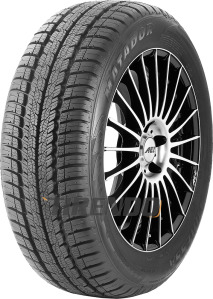
MATADOR has prepared for its customers a completely new product – the all-season tyre MP 61 ADHESSA suitable for all seasons. This tyre can guide the vehicle successfully all year around in each weather. Never mind if you are driving in hot summer, rain or snow ADHESSA will always bring you safely to your destination. The harmony of treat pattern configuration and the rich lamella pattern create conditions for safe and comfortable driving in mild climatic conditions. Another advantage of ADHESSA is its maintenance-free life-long operation which reduces the tyre-replacement costs.
directional tread pattern whose configuration and lamellas are adjusted to safe driving in summer on dry and wet road and in winter on ice and snow. The driving properties on snow are improved by special tread compound with high SILICA content. A new compound which improves considerably the average lifetime of MP 61 ADHESSA in comparison with summer tyres. Advantageous economic operation – reduced costs caused by very good mileage and maintenance-free operation saving tyre-replacement and service costs.
Application of ADHESSA tyres
ADHESSA tyres are suitable for drivers who drive on various types of roads mainly in flat lands or big industrial areas where the climatic and driving conditions change quickly and unexpectedly
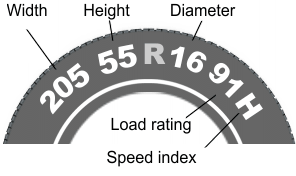
They can be also used in mild winter conditions. They are produced in a wide assortment of sizes ranging from 13“ to 17“ in the speed categories „T“ up to 190 km/h, „H“ up to 210 km/h and „V“ up to 240 km/h
MP 61 ADHESSA is characteristic for:
Directional tread pattern whose configuration and lamellas are adjusted to safe driving in summer on dry and wet road and in winter on ice and snow
The driving properties on snow are improved by special tread compound with high SILICA content
A new compound which improves considerably the average lifetime of MP 61 ADHESSA in comparison with summer tyres
Advantageous economic operation – reduced costs caused by very good mileage and maintenance-free operation saving tyre-replacement and service costs
Function of ADHESSA tread pattern
Configuration of shoulder blocks:
optimated shape for demanding conditions of round-the-year operation
high rigidity during the output transmission at high friction forces characteristic for dry roads
sufficient flexibility during the output transmission at low friction forces characteristic for snowy and icy roads
Configuration of inner strips:
It guarantees high adhesion on wet roads
Circumferential grooves:
They give the tread pattern excellent steering ability and accuracy
Their configuration and volume guarantees optimal properties on wet surface
Broad cross grooves:
They lead away water from the track effectively and reduce the danger of aquaplaning
They enable gripping on snow and slush thus providing similar gripping as special winter tyres
Dense lamellas:
Similarly as with winter tread pattern it increases the gripping and braking properties in winter conditions, especially on icy surface
A big amount of additional contact edges increases the adhesion on wet surface and gives a feeling of better safety and steering ability of the vehicle
It contributes to quiet rolling of the tyre and reduced noise
New generation of lamellas:
It locks the indented tread pattern blocks in all directions thus increasing their rigidity and effectiveness in marginal conditions of maximum engine output transfer on dry and wet road
Guiding groove:
It increases stability and keeps the track also at high speeds
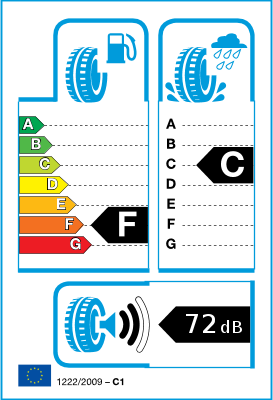
The European Union has introduced the EU Tyre Label by Regulation (No. 1222/2009) identically and bindingly for all EU member states. It applies to passenger car tyres, light commercial vehicle tyres and heavy commercial vehicle tyres produced after 01.07.2012.
Three different areas are tested: rolling resistance, wet grip and the rolling noise the tyre makes on the road.
The following are not affected by the EU Tyre Label: retreaded tyres, professional off-road tyres, racing tyres, tyres with additional devices to improve traction such as spiked tyres, T-type emergency tyres, special tyres for fitting to vehicles first registered before 1 October 1990, tyres with a maximum authorised speed of 80 km/h, tyres for rims with a nominal diameter of 254 mm or less or 635 mm or more.
With this regulation, the European Union is pursuing the goal of promoting economic and ecological efficiency in road traffic as well as increasing road safety on the one hand, and on the other hand, granting consumers more product transparency and at the same time serving as an active decision-making aid.
Already during the incorporation, experts criticise the fact that the EU Tyre Label unfortunately only shows a few product characteristics. Apart from rolling resistance, wet grip and rolling noise, which are the main focus of EU tyre labelling, tyres have much more important and safety-relevant product characteristics, such as aquaplaning properties, driving stability, service life, braking properties on dry and wet roads, behaviour in wintry conditions, etc.
Tyre manufacturers point out that test results from various institutions and journals remain an important information medium for the end consumer. These tests usually focus on further safety-relevant product characteristics besides the EU standard qualifications for tyre labelling, which are always important for the final customer.
MP61 tyre review
Average based on 4 test results
Grip in dry conditions
Braking in dry conditions
Grip in wet conditions
Braking in wet conditions
Grip in snow
Driving comfort
Internal noise level
Tyre wear
Fuel consumption
Kilometers driven234,533
22.09.2010frompatriche bogdan excellent on gravel and wet conditions, good on tarmac, doesn't squeak in corners taken pedal-to-the-metal, good on snow for about 15-20.000 km on the front wheels (for FWD vehicles)





 %service-partner-advantages-list%