

4.31
The efficiency class label evaluated based on customer preferences.
Delticom centralized survey results from more than 40.000 customers from 15 European countries and created this index.
More than 5 billion kilometers. Testcauciucuri.com offers over 430 000 tests firsthand - from consumers for consumers.
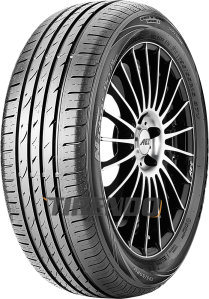
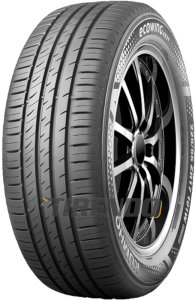
(The rim on the picture is for illustrative purposes only.)
Nexen N blue HD Plus
205/55 R16 91V 4PR
-
1 x Nexen N blue HD Plus 205/55 R16 91V 4PR =€ 58.701 x Castrol 5 Litre Canister =€ 39.87
- Description
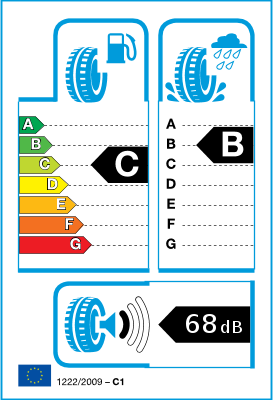
- EU Tyre Label:
- Client reviews rating
Get Closer to Nature More Safely on N'blue HD Plus
Do you have your own way of releasing stress? Some people go up a mountain and shout while others listen to music or confide in their friends. You may want to go on a drive to ease your stress if you are a Nexen Tire fan. A drive for its own sake when you are down or just feeling gloomy will put you in a much better mood. To better help you with your drive for a change of mood or a release of stress, Nexen Tire has launched a new, exciting product: N’blue HD Plus, an upgraded version of N’blue HD with better performance and improved features that are the product of extensive investment in R&D.
Key Performance
Utmost Handling Performance
Efficient water drainage: Computer simulated four circumferential grooves and slightly curved lateral grooves effectively evacuate water and resist hydroplaning.
Outstanding straight driving stability: Continuous 3 center ribs help directional driving stability at a high speed.
Maximized Wet Performance
Jointless Bead Wire & High Hardness Bead Filler: Improve high speed stability and deliver better handling and steering response.
Maximized Wet Grip Compound: By applying the latest silica & advanced materials compounding technology, Maximized wet grip and higher fuel efficiency are secured at same time.
Reduced Rolling Resistance
High performance cornering: Solid shoulder rib facilitates precise cornering and keeps in tune with every corner by distributing forces.
Excellent driving stability in wet roads: Lateral grooves achieved by effective drainage enhance driving stability in wet roads.
Optimized Best Contour System (OBCS)
High Tensile Steel Belts: Enhance braking function with optimized grip pressure and stress dispersion by OBCS technology.
Optimized Carcass Contour System (OCCS)
High Modulus Carcass: Minimizes tire deformation and helps maintain the tire's shape to enhance driving stability with OCCS technology.
Put differently, based on the EU Labeling standard for easier comparison, the tire has better wet grip, rolling resistance and noise performance. With improved stability on wet roads, the N’blue HD Plus received many ‘A’s in wet braking, the highest level under the EU Labeling standard.Its wet grip, one aspect of a tire highly regarded in Europe, has also been improved, as 18 out of its 44 categories previously rated B received A. In addition, 16 categories in rolling resistance and 15 categories in noise were rated higher, allowing the tire to provide a higher level of silence and better ride. Its fuel efficiency is higher now, with 5 percent more mileage compared to its predecessor. Nexen Tire is committed to delivering higher quality and performance to customers through continued improvement and sustained investment in R&D.
Introduction
Since 1st November, 2012 all tyres made after 1st July, 2012 must show the European Tyre Label.
Benefits
The European Union has developed this new provision to promote economic and ecological efficiency and ensure road safety.
Disadvantages The Tyre Label can provide an overview and give the customer more transparency, but it only covers three criteria. For an extensive evaluation of a tyre, however, far more performance characteristics are relevant. Especially in the search for suitable winter tyres the test results from different test institutions such as the ADAC are much more stringent.
We'd like to point out that it is the manufacturer that labels the tyre and provides us with this information. If you do not find the label values, either the manufacturer did not inform us of the label, or the product was manufactured before July, 2012. Before that date, tyres had not yet been required to carry a label, so in some cases it is possible to purchase a tyre without a Tyre Label.
Symbols
The tyres are classified in terms of three performance characteristics:
• Fuel Efficiency (letters A to G)
• Wet Grip (letters A to G)
• External Noise
Take action
Finally, it is the driver that determines the fuel consumption. In order to reduce this over the long-term, by being careful during acceleration drivers can become more fuel-efficient and environmentally conscious.
Regularly checking tyre pressure helps to improve rolling resistance, reduces energy loss, and supports optimum adhesion in wet conditions. To reduce the risk of accidents and ensure your and the safety of other road users, always keep a reasonable distance.
More information: http://ec.europa.eu/energy/efficiency/tyres/labelling_en.htm
Choose from our large online selection or ask us for advice. Our experts are happy to help you choose the appropriate tyres from our extensive range of products.
The classification in terms of fuel efficiency is divided into seven classes, from the A-class (the highest) to G-class (the lowest). A tyre in the A-class consumes 0.1 litres less at 100km than a tyre in the B-class. An essential component for fuel efficiency is the rolling resistance or rolling friction.
Rolling Resistance
Rolling resistance is the force that opposes motion. It is formed, for example, when a wheel is rolling. Rolling resistance depends not only on the geometry but also on the properties of the material.
Average Average value is between C-E. Class D is not used.
It shows how efficient the vehicle can brake on wet roads. Wet grip is an important feature especially with summer tyres. Class A has the highest safety and the shortest braking distances. Class F has low security and the longest braking distance.
The wet grip classes are based on test driving on wet roads with a speed of approximately 80 km/h. The difference between the braking distance of the tyres is 3-5 feet per grade. E.g., the difference in braking distance between Class A and Class F are up to 18 metres.
Average The average value of the tyres is between class B-E. Class D and G is not used.
The symbol indicates the external rolling noise in decibels and as a 3 class sound wave symbol to clarify whether the tire can keep the recommended level. External rolling noise does not correspond to tyre noise inside the compartment.
A continuous sound level above 80 decibel can cause health problems.
Symbol
Three sound waves symbolize the worst results. These are the tyres that exceed the maximum limit of approval. A symbol of 2 sound waves have noise level that corresponds with the approved sound level. Tyres that are marked with 1 sound wave are over three decibel quieter than the approval.
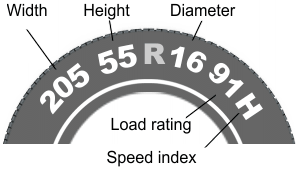
The exact size of a tyre can be found on its sidewall.
The following chart shows you how to read a tyre size.
2. The height as the ratio between the width and the height in %
3. Construction type: "R"= radial (often seen), "D" or "-"= diagonal (rarely seen)
4. The required rim diameter (in inches) for this tyre
5. Load index
6. Speed index